
Focus Group Transcription for Research Teams and Agencies
Learn how focus group transcription helps research teams capture themes, participant quotes, and analysis-ready notes from multi-speaker sessions.
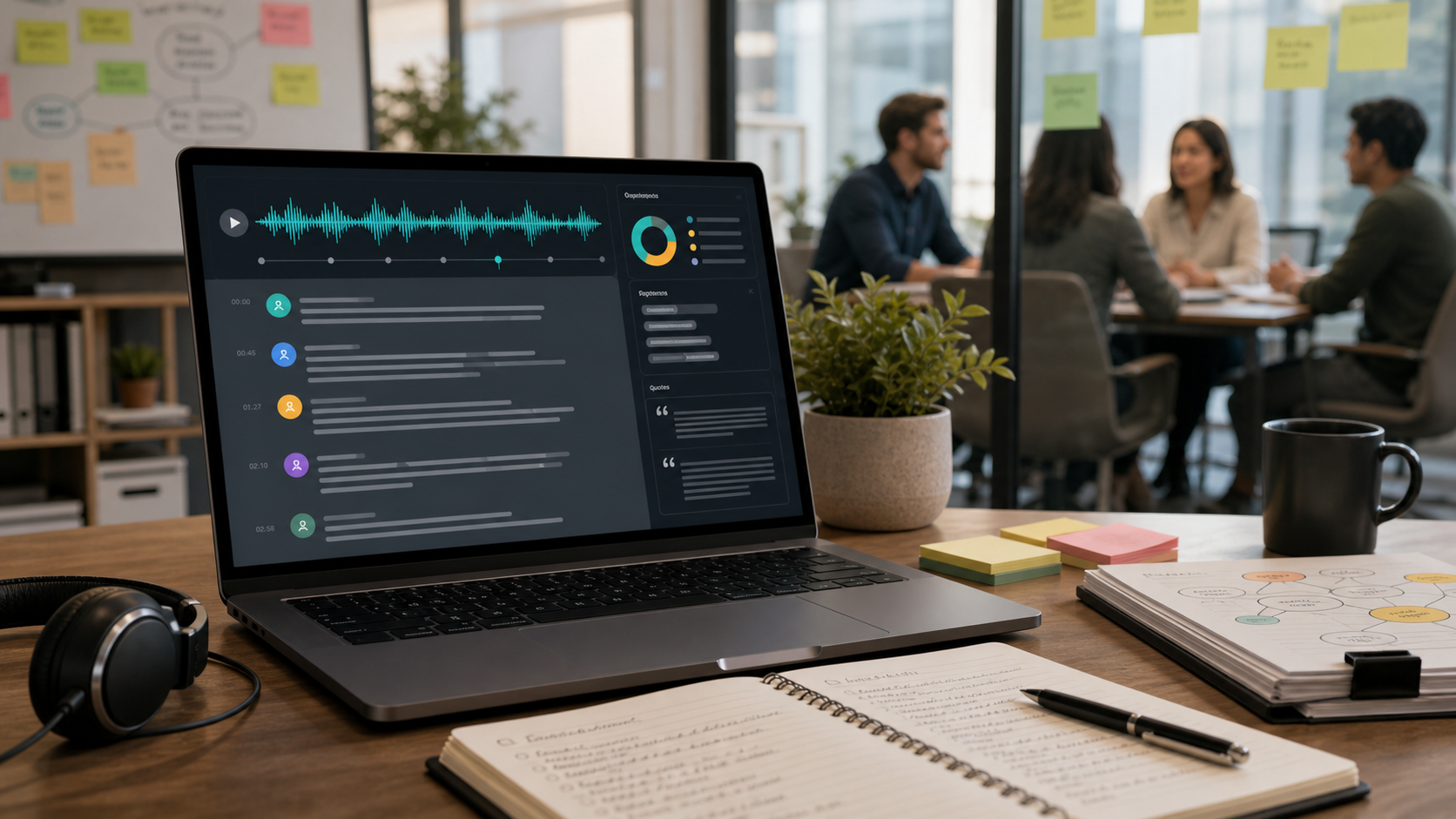
Focus Group Transcription for Research Teams and Agencies
Focus groups generate rich qualitative data, but they also create some of the hardest recordings to review manually. Multiple participants speak, ideas overlap, the moderator shifts topics quickly, and the most useful quotes may be scattered across a long session. Focus group transcription helps turn that complexity into something research teams can actually work with.
When the session becomes text, it is easier to move from raw conversation to analysis. Researchers can identify repeated themes, compare participant language, extract quotes, and build summaries without constantly replaying the recording. That saves time and improves consistency across the project.
Why focus groups are harder than simple interviews
A one-on-one interview is usually easier to follow because only two speakers are involved. Focus groups are different. There may be five, six, or eight participants, and several people may react to the same prompt in quick succession. That makes speaker tracking especially important.
In these sessions, a transcript becomes much more useful when it preserves:
- clear speaker changes
- timestamps for key moments
- readable formatting across long answers
- enough structure to isolate themes and quotes
That is why speaker identification is such an important feature for group research. It helps teams separate who said what instead of collapsing several responses into one block of text.
What researchers usually need from the transcript
Most research teams do not need the transcript only for archival purposes. They need it to support synthesis. That means they want to find patterns, compare reactions, capture exact wording, and support reporting with reliable evidence from the session.
For example, a transcript can help a team identify where participants consistently describe friction in onboarding, where they use the same phrase to describe trust concerns, or where an assumption from stakeholders is directly challenged by what participants actually say.
A practical workflow for focus group analysis
The simplest workflow is to record the session, generate the transcript, then review the text with themes in mind. Pull representative quotes, mark moments of disagreement or surprise, and organize sections by research question. If the discussion covered several prompts, it helps to split the transcript into those sections before writing the final report.
This is also where topics extraction and summary generation can reduce review time. Instead of starting with a full transcript and no structure, researchers get a faster path into the main patterns.
Why transcripts improve reporting quality
Research reporting becomes more credible when it is tied back to the exact language participants used. A transcript makes it easier to quote accurately, preserve nuance, and avoid over-generalizing from memory. It also helps agencies and in-house teams collaborate because everyone can review the same source material instead of depending on one person's notes.
This matters even more when several stakeholders want different cuts of the findings. With a searchable transcript, the team can return to the source and pull supporting evidence much faster.
Good use cases for focus group transcription
Focus group transcription is useful in product research, brand research, message testing, education studies, public sector research, media testing, and customer insight projects. Any session with multiple participants and qualitative analysis needs benefits from a more structured review process.
It is especially valuable when the team expects to revisit the data later. Text is much easier to reuse than raw audio when new questions come up after the initial report is delivered.
Final thought
Focus groups contain valuable nuance, but that value is much easier to unlock when the conversation becomes text. Transcripts make synthesis faster, quote collection easier, and cross-team review more dependable.
If your team runs focus groups regularly, use TranscriptionPlus to convert multi-speaker sessions into transcripts, summaries, and analysis-ready notes without relying only on manual review.