
User Interview Transcription for Product Research and UX Teams
See how user interview transcription helps product and UX teams capture quotes, themes, and decision-ready insights from research conversations.
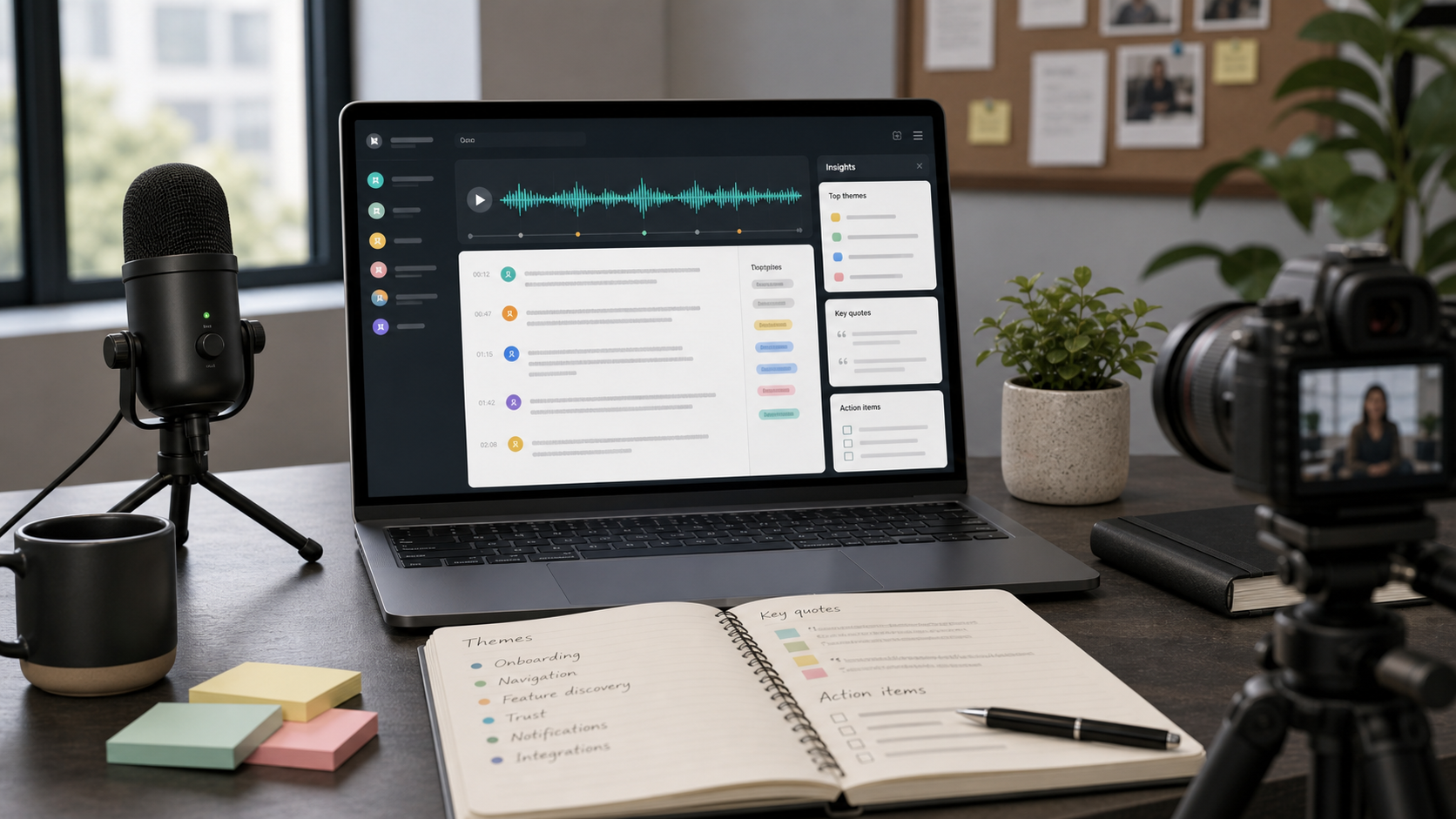
User Interview Transcription for Product Research and UX Teams
User interviews are one of the most valuable inputs a product team can gather, but they are also easy to underuse if the insight stays locked inside recordings. Product managers, designers, researchers, and founders often leave an interview with a few strong impressions, yet the deeper evidence is still buried in audio. User interview transcription helps bring that evidence into the working process.
Once the conversation becomes text, it is easier to review what the participant actually said, compare language across interviews, extract supporting quotes, and turn observations into themes. That is especially important when the team is trying to make decisions based on jobs to be done, onboarding friction, adoption blockers, workflow habits, or unmet needs.
Why transcripts are so useful in product research
Product research tends to generate nuanced insight rather than one clean answer. A participant may describe a pain point indirectly, reveal a workaround halfway through the interview, or use wording that becomes important only when the team compares several sessions side by side. A transcript gives the team a way to return to those moments without replaying every recording.
That improves several parts of the workflow:
- researchers can pull exact quotes for synthesis
- product managers can review evidence behind a finding
- designers can validate where friction appears in the journey
- stakeholders can access the substance without attending every session
The transcript becomes a bridge between the conversation itself and the decisions the team eventually makes.
What a strong user interview transcript should preserve
In product and UX research, clarity matters more than raw volume. The transcript should make it easy to tell who is speaking, where a key point begins, and how the conversation shifts between topics. That is why timestamps and speaker identification are so valuable.
These details help when you are reviewing several interviews at once. Instead of treating every conversation like one long block of text, the team can scan for repeated language, compare responses to the same prompt, and isolate the sections that matter most.
A simple workflow for synthesis
The most useful workflow is to transcribe the interview soon after it happens, review the summary, then tag or group the strongest moments by theme. Common categories might include onboarding, collaboration, trust, feature discovery, or reporting. From there, you can pull quotes into a synthesis doc and compare patterns across participants.
This becomes even easier when the workflow already supports topics extraction and summary generation. Those features do not replace analysis, but they do speed up the move from raw transcript to structured insight.
Why transcripts improve team alignment
Research often loses impact when only one person has full access to the source material. A transcript changes that. Product leaders, designers, and cross-functional partners can read the interview, review the participant's exact wording, and understand why a recommendation was made. That helps the team align around evidence instead of relying only on secondhand summaries.
It also makes it easier to revisit past research. When a new feature idea comes up three months later, the team can search earlier transcripts and see whether users already spoke about a similar need.
When user interview transcription is most valuable
User interview transcription is especially helpful for discovery research, usability testing debriefs, onboarding studies, churn interviews, customer development, and win-loss conversations. Any interview meant to influence product decisions benefits from a text record that can be searched, quoted, and reused later.
It is also valuable when research needs to scale across several stakeholders. Text makes the evidence more portable than audio alone.
Final thought
User interview transcription helps product and UX teams do more with the research they already invest in. It improves synthesis, supports better decision-making, and makes customer language easier to preserve inside the product process.
If your team runs user interviews regularly, use TranscriptionPlus to turn those conversations into searchable transcripts, summaries, and evidence-ready notes that are easier to share across the organization.